Architecture 2025-12-13 8 min read
Token-Based vs Session-Based Security: An Architect's Perspective
A practical breakdown of session vs token security, when to use which, and modern best practices.

Sagar Thakkar
AI Systems Architect

Below is the simplest, most practical breakdown of Token-Based vs Session-Based security.
✅ Session-Based Security (Traditional Web Login)
How Session-Based Security Works
- User logs in.
- Server creates a session object and keeps it in memory, DB, or cache (e.g., Redis).
- A session ID is stored in a browser cookie.
- Client sends the cookie with every request.

Session-Based Characteristics
- Server maintains state.
- Sessions expire or logout triggers invalidation.
- Good for classic web apps (monoliths, server-rendered).
Session-Based Pros
- Simple to implement.
- Easy to revoke sessions.
- Well supported by frameworks.
Session-Based Cons
- Doesn’t scale easily across multiple servers (needs sticky sessions or shared store like Redis).
- Mobile apps & APIs don’t fit well (cookies are tricky on mobile).
- Requires server memory/storage for each user session.
✅ Token-Based Security (Modern APIs & Mobile/Web)
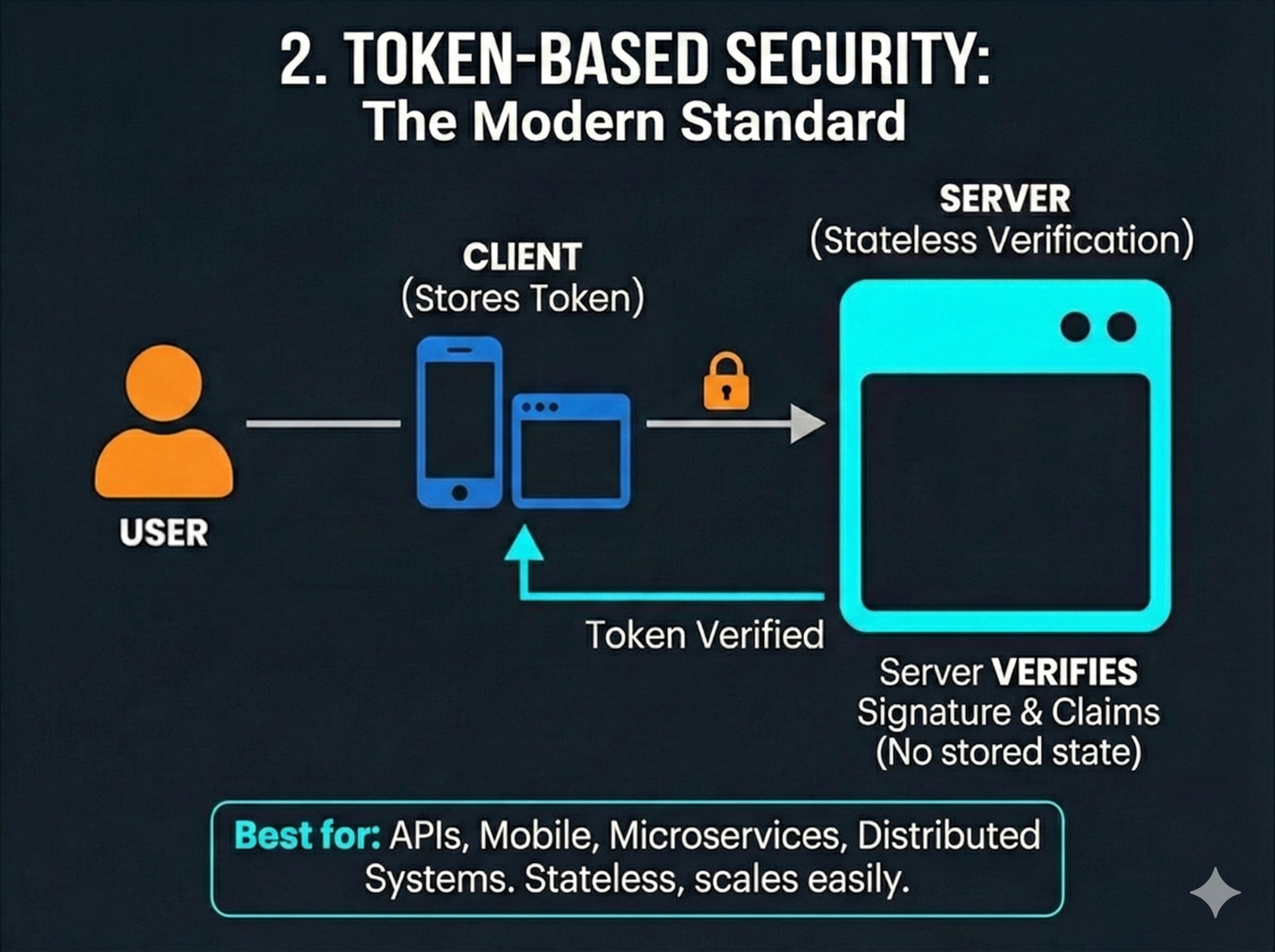
How Token-Based Security Works
- User logs in.
- Server generates a token (JWT, opaque token, PASETO) and signs it.
- Token is sent to client and included in every request (usually in
Authorizationheader). - Server does not store session state - it validates the signature to trust the token.
Token-Based Characteristics
- Stateless.
- Scales horizontally easily.
- Works across mobile, web, APIs, and microservices.
Token-Based Pros
- Perfect for distributed systems.
- No session storage required on server.
- Easy to integrate with third parties.
- Works across domains (CORS friendly).
Token-Based Cons
- Harder to revoke (token is valid until expiry unless you maintain a blacklist/allowlist).
- Larger attack surface if token is stolen (especially if stored in
localStorage).
🆚 Simple Comparison in One Line

| Feature | Session-Based | Token-Based |
|---|---|---|
| Server stores session? | Yes | No |
| Scales easily? | No | Yes |
| Best for | Web apps | APIs, mobile, microservices |
| Revocation | Easy | Harder |
| Implementation | Simple | Requires careful design |
🧠 Architect-Level Guidance - What Else You MUST Know in 2025
1️⃣ JWT is NOT always the right choice
People overuse JWTs. Use JWTs when:
- You need cross-service trust.
- You have distributed microservices.
- You avoid session storage by design.
Avoid JWTs when:
- You need quick revocation options.
- You don’t trust clients fully.
- Sessions are short-lived and centralized.
2️⃣ PASETO is the modern, safer alternative to JWT
- JWT has known pitfalls (alg confusion, signature issues).
- PASETO (Platform-Agnostic Security Tokens) fixes those by design.
3️⃣ OAuth2 / OpenID Connect ≠ Token-Based Auth
These are protocols, not just “authentication methods”. They use tokens, but solve:
- Authorization delegation.
- Identity federation.
- SSO (Single Sign-On).
4️⃣ Zero-Trust Security Models Prefer Tokens
In microservices, you need:
- Mutual TLS (mTLS).
- Service-to-service tokens.
- No server-stored sessions.
5️⃣ For Internal Enterprise Apps → Hybrid Approach
- Use Session cookies for browser UX.
- Use Token exchange for APIs. Both can co-exist and are common in modern systems.
6️⃣ For Mobile Apps → ALWAYS Token-Based
- Sessions break easily on mobile networks.
- Tokens are the standard for resilience.